
 Facebook
 X
X
 Pinterest
 Copy Link
If you live in Lincoln Park, chances are you’ve heard plenty about Lincoln Park water bills lately.
The issue has generated significant concern throughout the community, including a recent City Council meeting that drew so many residents that City Hall reached capacity and some people were unable to get inside.
And it’s understandable why homeowners are concerned: when household budgets are already stretched, even another $20, $30 or $50 on a utility bill matters.
So rather than debate who’s right or wrong, let’s focus on something more useful:
What can Lincoln Park homeowners actually do right now?
First, Why Are Lincoln Park Water Bills Increasing?
The City of Lincoln Park has approved new water and sewer rates that take effect September 1, 2026.
According to information released by the city, several issues are contributing to the increases, including aging water and sewer infrastructure, operating expenses and significant water loss within the municipal system.
The city has reported system water loss exceeding 40%.
Local news reports indicate that the effect on an individual household can vary depending upon water usage, with increases generally estimated in the range of approximately 15% to 28%.
That’s a substantial increase for many households.
But here’s something important:
A higher dollar amount doesn’t necessarily mean all of the increase came from the new rates.
Before your next bill arrives, there are several things worth checking.
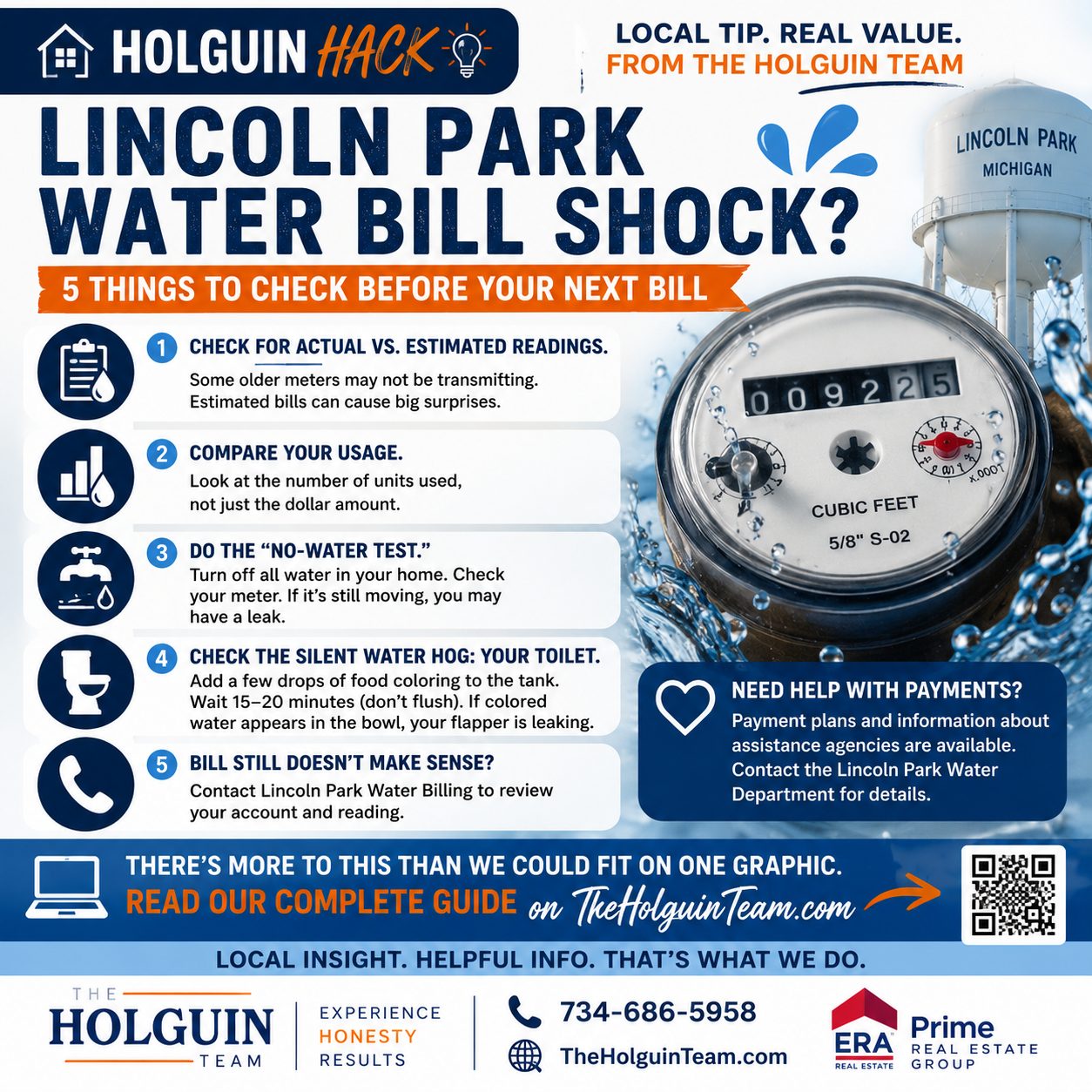
1. Check Whether Your Reading Is ACTUAL or ESTIMATED
This is probably the first thing I’d look at.
Lincoln Park has acknowledged problems with some older water meters not properly transmitting readings. As a result, some customers have received bills based on estimated usage.
According to the city, when an actual meter reading is eventually obtained, the account is adjusted accordingly.
So when your bill arrives, don’t look only at the amount due.
Look at the meter reading and determine whether your usage was actually measured or estimated.
If something doesn’t look right, contact the Lincoln Park Water Department and ask them to review it.
2. Compare WATER USAGE — Not Just Dollars
Suppose your previous bill was $190 and the new bill is $245.
It’s natural to immediately think:
“My water usage went way up!”
But that’s not necessarily what happened.
Compare the number of units of water used on your current bill with previous billing periods.
If your usage remained relatively consistent but the dollar amount increased, the new rates may explain much of the difference.
However, if the number of units suddenly jumped substantially and nothing changed in your household, that’s worth investigating.
3. Try the “No-Water Test”
Here’s a simple homeowner hack.
Pick a time when nobody needs water for a little while.
Turn off everything in the house that uses water.
No faucets.
No dishwasher.
No washing machine.
Don’t flush the toilets.
Then check your water meter.
If the meter continues registering water usage when absolutely nothing should be using water, you may have a leak somewhere in the home.
Even a relatively small leak running 24 hours a day can add up over an entire billing period.
4. Check One of the Biggest Hidden Water Wasters: Your Toilet
A toilet can leak without making much noise.
Here’s an easy test.
Put a few drops of food coloring into the toilet tank.
Don’t flush.
Wait approximately 15–20 minutes.
Then look inside the toilet bowl.
If colored water has appeared in the bowl, water is leaking from the tank—often because of an inexpensive flapper or another component inside the tank.
A small repair could prevent hundreds or even thousands of gallons of water from being wasted over time.
5. Look for Other Sneaky Water Users
Check around your home for:
- Dripping faucets
- Running toilets
- Leaking outdoor spigots
- Washing-machine connections
- Dishwasher supply lines
- Water heater connections
- Irrigation or sprinkler systems
- Damp areas around plumbing fixtures
Also compare your usage seasonally.
Watering lawns, filling pools, washing vehicles and other summer activities can make warm-weather consumption considerably different from winter usage.
6. If Your Bill Doesn’t Make Sense, Ask Questions
Residents aren’t required to simply look at a surprising bill and wonder what happened.
If your water usage seems unusually high, your meter reading appears questionable or you believe something about the account is incorrect, contact the Lincoln Park Water Department and ask them to review the account and meter information with you.
One important clarification:
The Michigan Public Service Commission regulates several types of utilities in Michigan, but municipal water service generally isn’t handled through the MPSC utility-complaint process.
For a Lincoln Park municipal water billing question, start with the City of Lincoln Park Water Department.
7. If Paying the Bill Is Becoming Difficult, Ask About Assistance
This may be the most important part of this article.
A utility increase that seems manageable to one household can create a genuine hardship for another.
The City of Lincoln Park says payment arrangements may be available and that residents can obtain information about agencies that offer assistance.
If you’re struggling with the bill, don’t wait until the situation becomes significantly worse.
Contact the Water Department and ask specifically:
“What payment arrangements or assistance programs are currently available to me?”
There is absolutely nothing wrong with asking what resources exist.
Changes Are Also Coming to Lincoln Park’s Water Meters
The city is undertaking a water-meter replacement program.
According to information published by Lincoln Park, the newer system should eventually give residents better access to their own water-consumption information, including tools that may make it easier to identify unusual usage or potential leaks.
That’s something homeowners should take advantage of when it becomes available.
Being able to see unusual water consumption sooner could help residents discover a running toilet or hidden leak before several weeks of wasted water appear on the next bill.
The Bottom Line
Lincoln Park residents have legitimate questions about rising water and sewer costs, and the community discussion surrounding those increases will undoubtedly continue.
But homeowners don’t have to wait for that larger debate to be resolved their Lincoln Park water bills before taking action inside their own homes.
Check your meter reading. Compare your actual usage. Look for leaks. Test your toilets. Question unusual readings. And if the bill is creating financial hardship, ask what assistance is available.
Sometimes the best homeowner “hack” isn’t complicated.
It’s simply knowing what to check, what questions to ask and where to go for help.
Helpful Resources
City of Lincoln Park — Water & Sewer Rates
Visit the City of Lincoln Park website for current rates, city information and Water Department resources.
Michigan Public Service Commission
The MPSC provides information about the Michigan utilities and services that fall under its regulatory authority.
The Holguin Team has been serving Metro Detroit and Downriver since 1996. Our goal isn’t simply to help people buy and sell houses—we want to be a useful resource for homeowners throughout the communities we serve.
Tony & Kelly Holguin | The Holguin Team
ERA Prime Real Estate Group
734-686-5958 | TheHolguinTeam.com
For more homeowner information and local real estate resources, visit our Downriver real estate blog.
